

Fleet Tracking for Freight Dispatch: Why Every UAE Service Needs It
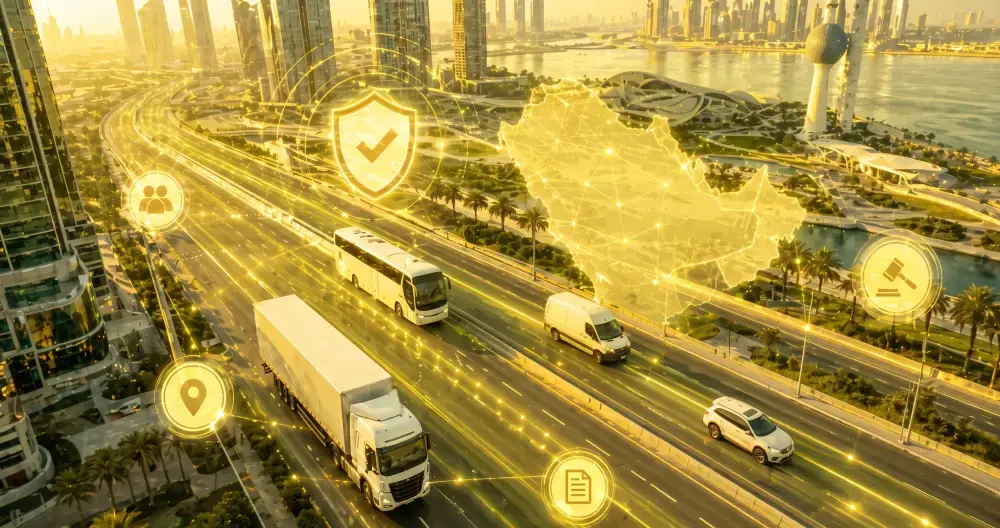
Do you know where your trucks are right now? If you run a UAE freight dispatch business, customers ask this all day. One truck is at Jebel Ali, another is leaving Dubai Investment Park, and a van is heading to Sharjah. Calling every driver takes too much time.
Fleet tracking makes this simple. You can see your vehicles on a map, plan trips better, and tell customers early if a delivery will be late.
What Fleet Tracking Means for a Freight Dispatch Business
Fleet tracking uses GPS hardware and software to collect information about your vehicle fleet. Most systems offer a map interface, where one can view the vehicles in real time. The following information is usually available, depending on the system specs:
- Vehicle’s current position and heading
- Speed and driving patterns in terms of acceleration, braking and idling
- Distance driven and past trips
This provides a good overview for a fleet management team.
Live Vehicle Tracking Keeps Everyone Informed
Live vehicle tracking is a must in any dispatch business. If a customer in Al Quoz comes asking about the status of their delivery, the dispatcher should not have to call the driver every time to ask where they are. Benefits of this kind of tracking include:
- More informative customer support: Being able to tell the customer’s exact whereabouts enables one to provide more detailed delivery estimates.
- Easier rerouting: In case a driver has finished a delivery in Ajman ahead of schedule, they can be sent to another nearby pickup/delivery point.
- Proactive customer notification: Delays can be communicated to the customer in advance, preventing them from having to call the dispatcher.
- Geofence alerts: If applicable, the system should notify the user when a vehicle enters or exits a particular location, such as a port or a warehouse.
Smarter Route Planning on UAE Roads
The UAE has some great highways; however, traffic can cause intolerable delays, especially on Sheikh Zayed Road, Emirates Road, and the highway belt between Dubai and Abu Dhabi. Moreover, there are traffic restrictions for commercial vehicles in several areas; hence, a UAE-based dispatcher should be aware of the legal driving conditions in whichever emirate they operate in. With tracking comes the ability to:
- Plan ahead and avoid slow traffic whenever possible
- Bundle nearby pickups and deliveries with a single truck
- Devise alternate routes based on current traffic conditions and past experience
- Optimize trips by analyzing recorded data
Route planning ceases to be a day-to-day chore and transforms into a strategic asset.
How Fleet Tracking Reduces Delivery Delays
Delays are often the result of several small occurrences, not a single major issue. A few minutes here and there, and the delivery is no longer on time. Some of the reasons for this could include:
- Long waits at a gate or terminal
- Unplanned detours and deviations
- Unexpected traffic jams which were not on the radar of the dispatcher
With tracking, such issues become apparent, while they can still be solved. If a dispatcher notices that a truck has spent more than two hours waiting at a terminal, they could call the agent to request faster processing or reassign the truck to another nearby delivery. Recorded data is also vital in such cases, as it allows the dispatcher to show the customer why the delivery was late, thus fostering better communication and planning for the future.
Driver Monitoring for Safer Driving
Monitoring of drivers is meant to facilitate safety and fair compensation, and not necessarily to keep track of “bad” behaviors. This is especially important in the UAE, where driving on the highway is fast, and the summer temperatures are severely trying on the machines. Several systems report on the following:
- Hard braking and accelerating
- Speeding
- Idling and deviation from planned stops
When used correctly, such data can be used to train or motivate drivers. If a particular driver has a consistent pattern of hard braking, they may need to be pulled in for retraining, while a driver who maintains good statistics can be rewarded. Good data also protects honest drivers from accusations, and it is a good idea to explain to them what exactly is being tracked and why.
Better Fuel Efficiency and Lower Running Costs
Fuel is usually the single largest expense for any freight company, and tracking can be instrumental in identifying sources of unnecessary consumption. Some of the issues which might be resolved with tracking include:
- Long idling while waiting for a gate to open
- Unjustified detours
- Aggressive driving patterns
- Poor maintenance resulting in higher fuel consumption
There is no need to revise the entire fleet maintenance policy right away, but minor optimizations such as shortening the route, reducing wait time, and encouraging drivers to drive smoothly can have a noticeable effect. Especially if the software keeps track of distance and idling time, it can be used to optimize servicing intervals, which in turn affects fuel efficiency. In general, regular servicing of vehicles reduces the risk of mechanical failures but also improves performance, which is especially important under the extreme temperatures of the UAE.
Security for Cargo and Vehicles
Many transport jobs deal with high-value or time-sensitive cargo, such as electronics, medical equipment, and perishable foods. Location tracking provides an extra layer of security in such cases, as it allows the dispatcher to know whether the vehicle has deviated from the planned route. This is especially important for high-value cargo. Depending on the system, the dispatcher may receive an alert in case of:
- Unauthorized vehicle movement
- Suspicious stops and deviations outside of working hours
In case of theft or hijacking, the information about the vehicle’s last known location may come in handy. Tracking can also be used to prevent unauthorized use of the company’s vehicles, and the recorded data serves as proof of delivery, which is reassuring for both parties.
Stronger Fleet Management
Outside of day-to-day operations, tracking serves another useful purpose – it helps the management to get a good understanding of the bigger picture. For instance, a dispatcher can analyze the data and come up with suggestions based on:
- Which vehicles see regular use, which are idle, and which are too costly to maintain
- Whether it is a good idea to scale up/shut down the current operations based on available resources
- How the tracking data can be used to improve the efficiency of the dispatch business
Such information is invaluable for a growing dispatch company based in the UAE.
How to Get Started with Fleet Tracking
It is a good idea to identify the primary area of concern first. This will allow the dispatcher to pick the system best suited for their current needs.
- Late deliveries: Live tracking would be more important in this case.
- Higher costs: Fuel consumption and vehicle idling should be monitored first.
- Day-to-day operations: Get a system which will offer easy daily use for the dispatcher team, cover the emirates needed, and scale with the growth of the fleet.
Najoom Al Thuraya offers GPS tracking and fleet management services, including a real-time GPS tracker for trucks, for businesses looking to get visibility into their fleet and analyze journey data. If your transport/logistics business needs to begin tracking vehicles, contact us today.